
10 Real-Life Examples of Artificial Intelligence You Use Every Day
Key Takeaways
- Artificial intelligence is already part of daily life through many technologies people use every day.
- AI helps systems analyze data, recognize patterns, and provide useful recommendations.
- Many services such as navigation apps, voice assistants, and streaming platforms rely on AI.
- Understanding everyday AI examples helps people see how technology is evolving.
- AI tools assist human decisions but still require human supervision and responsible use.
Introduction: AI Is Already Around You
Many people think artificial intelligence is something futuristic.
Robots, science fiction movies, or advanced research labs often come to mind.
But the truth is much simpler.
Artificial intelligence is already part of everyday life.
From the moment you unlock your phone to the time you watch a movie online, AI systems may already be working in the background.
For example, when a navigation app suggests the fastest route or a streaming platform recommends a show you might like, those suggestions are often powered by artificial intelligence.
If you are new to the concept, you can start with our guide explaining what artificial intelligence is and how it works before exploring these examples.
In this article, we will look at 10 practical examples of artificial intelligence that many people use every day.
1. Voice Assistants

Voice assistants are one of the most familiar examples of AI.
They allow users to interact with devices using natural language.
Typical tasks include:
- Setting reminders
- Checking the weather
- Playing music
- Searching for information
The AI system processes spoken language and converts it into commands.
Behind the scenes, these systems rely on speech recognition and natural language processing, which allow computers to understand and respond to human speech.
2. Navigation and Traffic Prediction
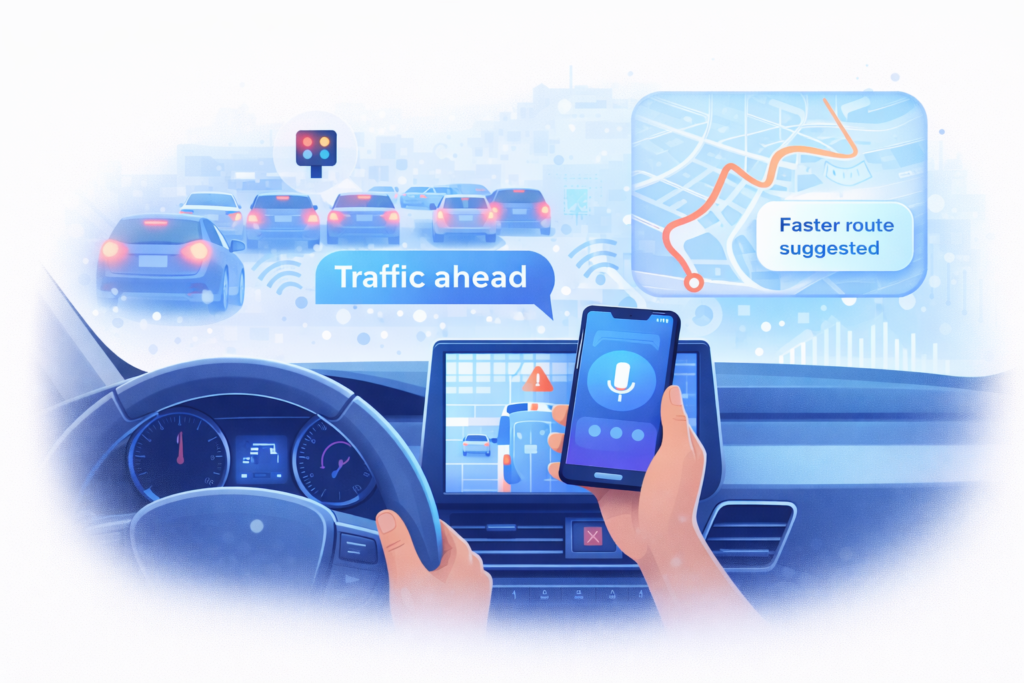
Navigation apps are another everyday use of artificial intelligence.
When you enter a destination, the system analyzes several factors such as:
- Current traffic conditions
- Road closures
- Historical travel data
Based on this information, the app suggests the fastest route.
AI models continuously analyze data from thousands of drivers to improve traffic predictions.
This is why many navigation apps can warn users about congestion before they reach it.
3. Online Shopping Recommendations
If you shop online, you have probably seen recommendations such as:
- “Customers also bought”
- “Recommended for you”
- “Similar products”
These suggestions are usually generated by AI recommendation systems.
The system studies patterns such as:
- Products you viewed
- Previous purchases
- Shopping behavior of similar users
Based on these patterns, AI predicts which products you may be interested in.
This helps online stores improve user experience and product discovery.
4. Streaming Platform Suggestions
Streaming platforms use artificial intelligence to recommend movies, shows, or music.
Instead of searching through thousands of titles, users receive personalized suggestions.
The recommendation system studies:
- Watch history
- Genres you prefer
- Ratings you give
- Viewing time patterns
This helps the platform suggest content that matches your interests.
Although the system is not always perfect, AI improves recommendations over time as it collects more data.
5. Email Spam Filters
Spam filters are a practical example of artificial intelligence that many people rely on without noticing.
AI systems analyze incoming emails and classify them as:
- important messages
- promotional content
- spam or suspicious emails
These systems learn patterns from millions of email examples.
Over time, the system becomes better at identifying unwanted messages and keeping inboxes organized.
6. Smart Home Devices
Smart home devices also use artificial intelligence to improve convenience.
Examples include:
- smart speakers
- automated lighting
- temperature control systems
These devices can learn user preferences and adjust settings automatically.
For example, a smart thermostat may learn when residents are usually at home and adjust temperature settings accordingly.
This type of automation helps improve comfort and energy efficiency.
7. Facial Recognition in Smartphones

Many smartphones use AI-powered facial recognition to unlock devices.
The system scans facial features and compares them with stored data to verify identity.
AI algorithms analyze details such as:
- face structure
- distance between facial features
- lighting conditions
While this technology improves convenience, experts recommend combining it with additional security methods when needed.
8. Customer Support Chatbots
Many websites now use chatbots to answer common customer questions.
Chatbots can help with tasks such as:
- answering product questions
- providing account information
- guiding users through troubleshooting steps
These systems rely on AI to understand questions and provide relevant responses.
Although complex issues may still require human support, chatbots help businesses handle basic inquiries more efficiently.
9. Social Media Content Recommendations
Social media platforms use artificial intelligence to decide which posts appear in your feed.
The system analyzes user behavior such as:
- posts you like
- accounts you follow
- content you watch or share
Based on this information, the platform prioritizes content that is more likely to interest you.
This process helps personalize the user experience but also raises discussions about algorithm transparency and responsible content management.
10. Fraud Detection in Financial Systems
Financial institutions use artificial intelligence to detect unusual transactions.
AI models analyze patterns such as:
- transaction location
- spending habits
- transaction frequency
If a transaction appears unusual, the system may flag it for review.
This helps banks identify potential fraud and protect customers from unauthorized transactions.
However, final decisions often involve human review to avoid incorrect alerts.
Expert Insight
Artificial intelligence works best when it supports human decision-making rather than replacing it.
AI systems are powerful tools for analyzing data and identifying patterns, but responsible use requires human oversight, transparency, and ethical guidelines.
Common Misconceptions About AI in Everyday Life
Many people misunderstand how artificial intelligence actually works.
Here are a few common misconceptions.
AI Is Only for Large Technology Companies
Today, AI tools are used across many industries including education, healthcare, retail, and transportation.
Even small businesses can access AI-powered tools through modern software platforms.
AI Systems Always Make Perfect Decisions
AI predictions depend on the quality of the data used to train the system.
If the data is incomplete or biased, the results may also be inaccurate.
For this reason, human supervision remains important.
AI Will Replace All Human Jobs
AI often automates repetitive tasks, but many roles evolve rather than disappear.
In many industries, people work alongside AI systems to improve efficiency and productivity.
Why Understanding Everyday AI Matters
Understanding how AI works in everyday life helps people become more informed technology users.
Instead of seeing AI as a mysterious concept, people can recognize it as a practical tool used to analyze information and improve services.
As artificial intelligence continues to develop, awareness and responsible use will become even more important.
Frequently Asked Questions (FAQ)
1. What are simple examples of artificial intelligence?
Common examples include voice assistants, navigation apps, streaming recommendations, spam filters, and smart home devices.
2. Is artificial intelligence used in smartphones?
Yes. Many smartphones use AI for facial recognition, voice assistants, camera enhancements, and predictive typing.
3. Are AI recommendations always accurate?
Not always. AI systems improve with more data but may still produce inaccurate suggestions in some situations.
4. Do small businesses use artificial intelligence?
Yes. Many software platforms now include AI features such as automation tools, analytics, and customer support chatbots.
5. Will AI continue to grow in everyday technology?
Most technology experts believe AI will continue expanding as computing power and data availability increase.
Conclusion
Artificial intelligence is no longer limited to research laboratories or futuristic concepts.
It is already integrated into many tools and services that people use daily.
From navigation apps to online shopping recommendations, AI systems analyze data and provide useful insights that make technology more convenient.
Understanding these everyday examples helps people see how artificial intelligence is shaping modern digital experiences.
As AI continues to evolve, the most effective systems will likely be those that combine human creativity with intelligent technology.