Key Takeaways
- SEO helps websites appear in Google search results.
- It is one of the most powerful sources of free website traffic.
- SEO includes on-page, off-page, and technical improvements.
- Consistent content and proper keywords are essential.
- Beginners should focus on simple SEO basics first.
Introduction: Why SEO Matters Today
Imagine you open a small shop in a busy market street. Hundreds of people walk past your store every day. Some notice your shop, step inside, and buy something.
Now imagine opening the same shop in a remote street where nobody passes.
Which one will generate more customers?
That’s exactly how websites work.
The internet has billions of pages, and search engines like Google decide which pages appear first when someone searches for information.
Unlock Your Success: SEO for Beginners Made Easy
SEO helps your website appear in front of the right people at the right time.
If you are completely new to online marketing, it helps to first understand the basics of digital marketing strategies. You can start with our Digital Marketing for Beginners guide, which explains the overall online marketing landscape.
In this article, we will focus on SEO specifically, including essential tips for seo for beginners, and explain it step by step in simple language.
What Is SEO?
SEO Explained in Simple Words
SEO stands for Search Engine Optimization.
It is the process of improving your website so that search engines understand your content and show it in search results.
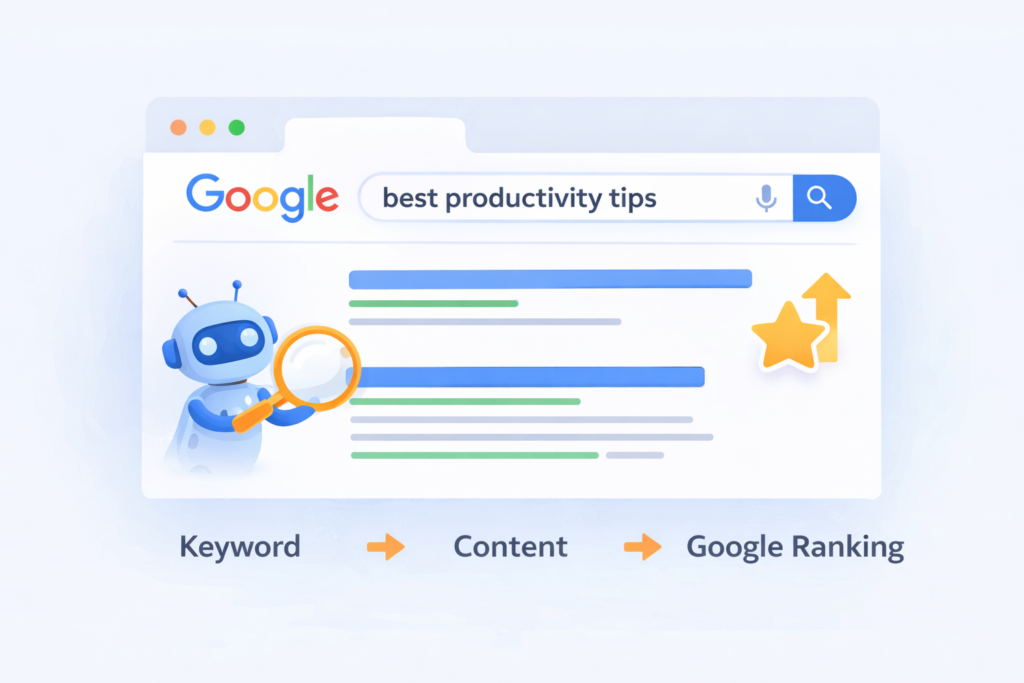
For example, if someone searches:
“best productivity tips”
Google scans millions of pages and displays the most relevant results.
SEO helps your content become one of those results.
Why SEO Is Important
SEO is valuable for several reasons:
- It brings free organic traffic
- It builds long-term visibility
- It improves website credibility
- It attracts people actively searching for solutions
Unlike paid advertisements, SEO results can continue bringing visitors for months or even years.
However, SEO requires patience and consistent effort.
How Search Engines Work
To understand SEO, you must first understand how search engines operate.
Search engines follow three main processes.
1. Crawling
Search engines use automated programs called crawlers or bots.
These bots scan websites and discover new pages.
They follow links and collect information about content.
2. Indexing
After scanning pages, search engines store them in a massive database called an index.
This index contains billions of webpages.
When users search something, the search engine retrieves results from this database.
3. Ranking
Ranking is the process of deciding which pages appear first.
Search engines consider many factors, including:
- Relevance of content
- Keyword usage
- Website credibility
- User experience
- Page speed
SEO helps optimize these factors.
Types of SEO
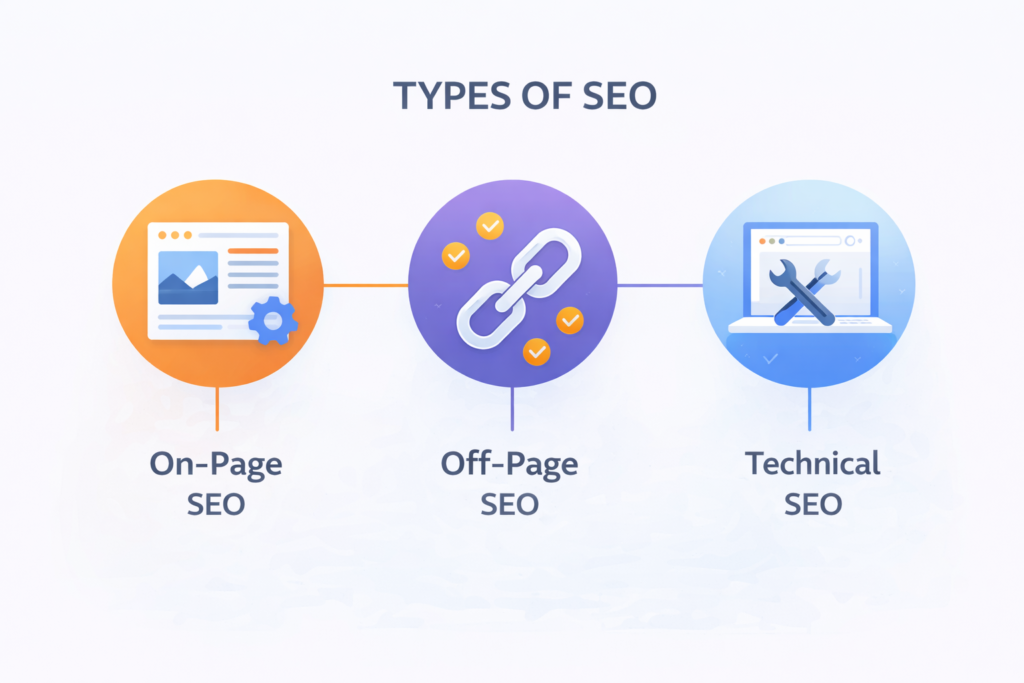
SEO is usually divided into three main categories.
1. On-Page SEO
On-page SEO refers to improvements made within your website content.
Examples include:
- Using relevant keywords
- Writing clear headings
- Optimizing images
- Creating helpful content
- Adding internal links
For beginners, on-page SEO is the most important place to start.
2. Off-Page SEO
Off-page SEO refers to actions outside your website that improve credibility.
One important factor is backlinks.
A backlink is when another website links to your content.
Search engines see backlinks as signals that your content is valuable.
However, quality matters more than quantity.
3. Technical SEO
Technical SEO focuses on website performance and structure.
Examples include:
- Mobile friendliness
- Fast page loading speed
- Secure HTTPS connection
- Proper site structure
- XML sitemaps
While beginners do not need advanced technical knowledge, basic site health is important.
Step-by-Step SEO Process for Beginners
SEO can seem complicated at first, but beginners can follow a simple process.
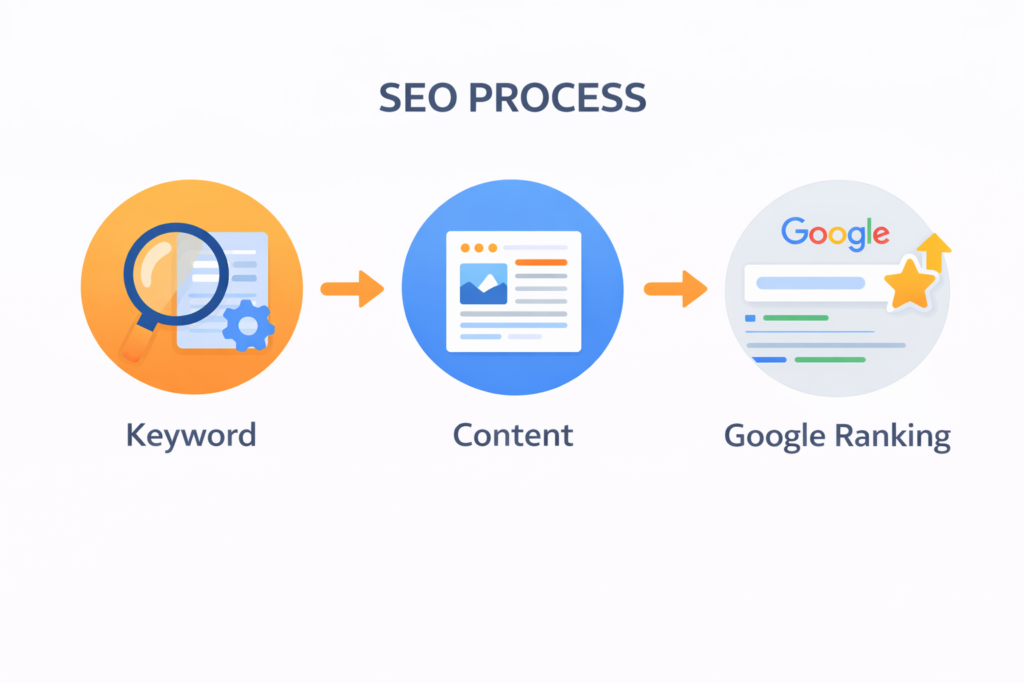
Step 1: Choose the Right Keywords
Keywords are the words people type into search engines.
Example:
- SEO for beginners
- how SEO works
- digital marketing basics
Use keywords that match what users are searching.
Beginner websites should focus on long-tail keywords, which are more specific and easier to rank.
Step 2: Create Helpful Content
Content is the foundation of SEO.
Instead of writing for search engines, write for people.
Good content should:
- Solve a problem
- Answer questions clearly
- Be easy to read
- Provide real value
Search engines reward useful content.
Step 3: Optimize Page Structure
Well-structured pages help search engines understand your content.
Best practices include:
- One clear H1 title
- Organized H2 and H3 headings
- Short paragraphs
- Bullet points where useful
Structure improves readability and SEO.
Step 4: Optimize Images
Images improve user experience, but they must be optimized.
Use:
- Descriptive file names
- Alt text descriptions
- Compressed file sizes
For example:
Alt text:
“SEO strategy diagram for beginners”
This helps search engines understand images.
Step 5: Build Internal Links
Internal linking connects related articles within your website.
For example, this article links to the Digital Marketing for Beginners guide, which explains the broader marketing ecosystem.
Internal links help search engines understand topic relationships.
They also help readers explore more content.
Real-World Example of SEO
Consider a travel blogger writing about budget travel tips.
If the article contains helpful advice, optimized keywords, and clear structure, it may begin appearing in Google results when people search:
“cheap travel tips”
Over time, the blog may receive thousands of visitors per month without paying for advertisements.
This is the long-term value of SEO.
Common SEO Mistakes Beginners Make
Many beginners struggle because of simple mistakes.
1. Keyword Stuffing
Repeating keywords too often makes content unnatural.
Search engines now prioritize natural writing, not keyword repetition.
2. Ignoring Search Intent
Search intent refers to what the user wants.
For example:
If someone searches:
“how to start a blog”
They expect a guide, not a sales page.
Understanding intent improves ranking.
3. Expecting Instant Results
SEO is a long-term strategy.
Results may take three to six months or longer.
Consistency matters more than speed.
SEO Tools Beginners Can Use
Several tools help beginners understand SEO performance.
Examples include:
- Google Search Console
- Google Analytics
- Keyword research tools
- Website speed analyzers
These tools provide insights about traffic, search queries, and website performance.
However, beginners should focus on learning fundamentals first, not relying entirely on tools.
Frequently Asked Questions
1. How long does SEO take to show results?
SEO results usually take several months. The timeline depends on competition, content quality, and website authority.
2. Is SEO free?
SEO does not require paying for ads, but it requires time, effort, and sometimes tools.
3. Can beginners learn SEO easily?
Yes. Beginners can learn SEO gradually by practicing keyword research, writing helpful content, and optimizing pages.
4. Do small websites benefit from SEO?
Yes. In fact, SEO can help small websites compete with larger brands by targeting specific keywords.
5. Is SEO still relevant today?
Yes. As long as people use search engines to find information, SEO will remain important.
Conclusion
SEO for beginners does not require advanced technical knowledge.
It begins with simple principles:
Understand what people are searching.
Create helpful content.
Structure your pages clearly.
Build credibility over time.
SEO rewards consistency and patience.
Instead of chasing quick tricks, focus on long-term value.
If you continue publishing useful content and improving your website step by step, search engines will gradually recognize your efforts.
And over time, that visibility can turn into meaningful traffic and growth.