
What Is Artificial Intelligence? A Simple Beginner’s Guide
Key Takeaways
- Artificial Intelligence (AI) refers to machines or software that can perform tasks that usually require human intelligence.
- AI is already part of daily life through smartphones, navigation apps, online shopping recommendations, and voice assistants.
- AI systems learn from large amounts of data to recognize patterns and make decisions.
- AI does not “think” like humans. It works based on algorithms and training data.
- Understanding AI helps people use technology more effectively and responsibly.
Introduction: The Technology You Already Use Every Day
Imagine waking up in the morning and asking your phone about the weather. Within seconds, you hear the answer.
Later, while driving to work, a navigation app shows the fastest route and avoids traffic. In the evening, a streaming platform suggests a movie that matches your taste.
Most people don’t realize it, but artificial intelligence is quietly working behind all these experiences.
AI is not just a futuristic idea anymore. It is already part of everyday life.
From smartphones to healthcare systems, from online shopping to customer support chatbots, AI is helping technology become smarter and more useful.
In this beginner-friendly guide, we will explore:
- What artificial intelligence really means
- How AI works in simple terms
- Real-world examples of AI
- What AI can and cannot do
By the end, you will have a clear understanding of why artificial intelligence is becoming one of the most important technologies of our time.
What Is Artificial Intelligence?
Artificial Intelligence, often called AI, refers to computer systems designed to perform tasks that normally require human intelligence.
These tasks may include:
- Understanding language
- Recognizing images
- Making decisions
- Learning from experience
- Solving problems
In simple terms, AI allows machines to analyze information and make intelligent responses.
However, it is important to understand that AI does not think like a human brain.
Instead, AI systems follow algorithms and patterns learned from large amounts of data.
For example:
A photo app can identify faces because it has been trained using millions of images. Over time, the system learns patterns that help it recognize people more accurately.
A Simple Way to Think About AI
Think of artificial intelligence as a very advanced pattern-recognition system.
It studies huge volumes of data and learns how to respond to similar situations in the future.
For example:
- Email spam filters learn which messages are likely spam.
- Streaming platforms learn which movies you may enjoy.
- Navigation apps learn which roads usually have traffic.
These systems improve over time as they process more data.
How Artificial Intelligence Works
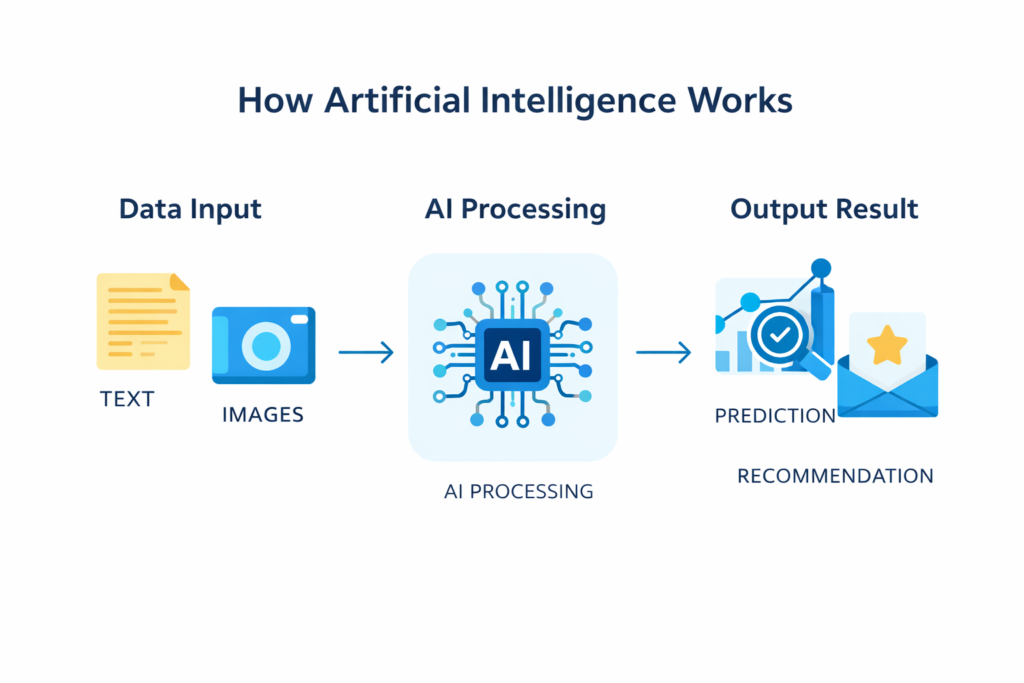
Artificial intelligence works through a combination of data, algorithms, and computing power.
Let’s break this down into simple steps.
1. Data Collection
AI systems need data to learn.
This data can include:
- Images
- Text
- Audio
- User behavior
- Sensor information
For example, a voice assistant must process thousands of hours of speech data to understand different accents and languages.
2. Training the System
Once the data is collected, the AI system is trained using algorithms.
During training, the system learns patterns and relationships in the data.
For example:
If an AI system is trained to recognize cats in photos, it studies thousands of images labeled as “cat” and “not cat.”
Over time, it learns the visual features that define a cat.
3. Making Predictions
After training, the AI system can analyze new data and make predictions.
For example:
- A recommendation engine suggests products you may like.
- A fraud detection system identifies suspicious transactions.
- A language model generates text responses.
The more data the system receives, the better its predictions usually become.
Real-World Examples of Artificial Intelligence
Many people assume AI is only used in advanced laboratories or research centers.
In reality, AI is already part of everyday technology.
Here are some common examples.
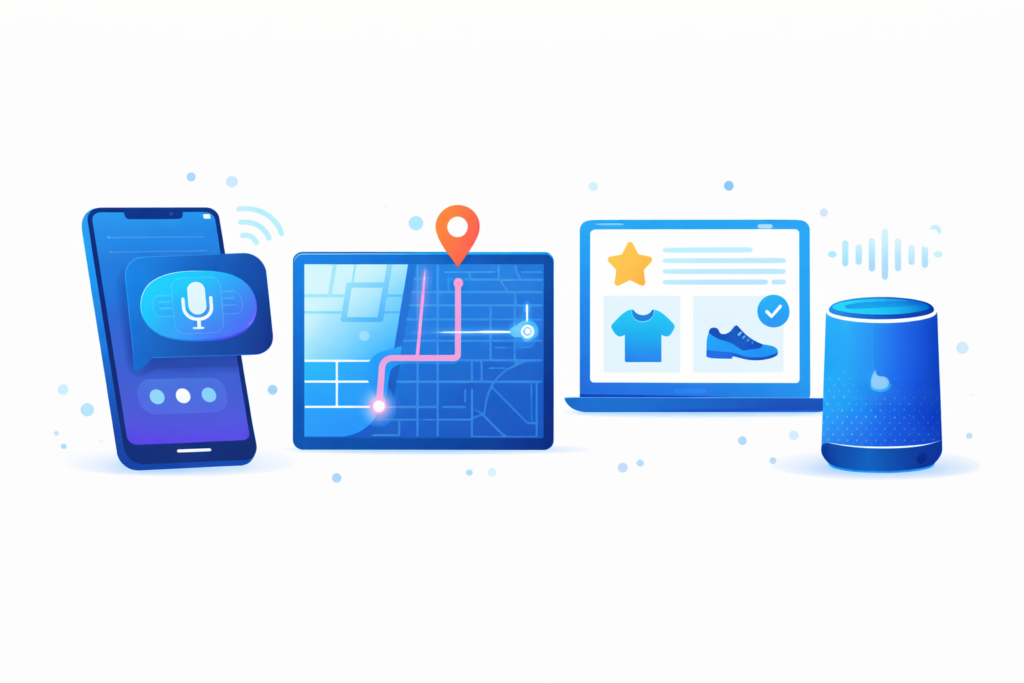
Voice Assistants
Voice assistants help users interact with technology using natural language.
They can perform tasks such as:
- Setting reminders
- Answering questions
- Controlling smart devices
- Searching the internet
These systems rely on AI to understand spoken language and provide useful responses.
Navigation and Maps
Modern navigation apps use AI to analyze traffic patterns.
They can predict:
- Road congestion
- Estimated travel time
- Alternative routes
This helps drivers reach destinations more efficiently.
Online Shopping Recommendations
E-commerce platforms use AI to recommend products based on browsing behavior.
For example:
If you search for headphones, the system may suggest similar products or accessories.
This recommendation system improves as it learns more about customer preferences.
Image Recognition
AI can recognize objects, faces, and scenes in images.
This technology is used in:
- Photo organization apps
- Security systems
- Medical imaging analysis
For instance, AI tools can help doctors identify patterns in medical scans that might require further examination.
Important note: AI tools assist professionals but do not replace expert judgment.
What AI Can Do Well
Artificial intelligence is powerful in certain areas.
Here are some strengths of AI systems.
Processing Large Amounts of Data
AI can analyze huge datasets much faster than humans.
This makes it useful for fields like:
- scientific research
- climate analysis
- financial risk detection
Identifying Patterns
AI excels at detecting patterns that may not be obvious.
Examples include:
- fraud detection
- product recommendations
- predictive maintenance in factories
Automating Repetitive Tasks
Many businesses use AI to automate routine work.
Examples include:
- customer support chatbots
- document classification
- automated scheduling
Automation helps organizations improve efficiency and reduce repetitive workloads.
What AI Cannot Do (Yet)
Despite its capabilities, AI has important limitations.
Understanding these limits helps maintain realistic expectations.
AI Does Not Have Human Emotions
AI systems do not feel emotions such as empathy or compassion.
They respond based on programmed rules and training data.
AI Does Not Truly Understand Context
Although AI can process language, it does not fully understand meaning the way humans do.
Sometimes AI systems produce incorrect or confusing answers if the input data is unclear.
AI Depends on Data Quality
AI systems learn from the data they are trained on.
If the training data is incomplete or biased, the results may also be inaccurate.
For this reason, responsible AI development requires careful data selection and human oversight.
Expert Tip
When using AI tools, think of them as assistants rather than decision-makers.
They can provide suggestions, automate tasks, and analyze information, but human judgment remains important.
Common Misconceptions About AI
Many myths surround artificial intelligence.
Let’s clarify a few common misunderstandings.
Myth 1: AI Will Replace All Jobs
AI is more likely to change how work is done rather than eliminate every job.
Many roles will evolve as people learn to work alongside intelligent tools.
Myth 2: AI Thinks Like Humans
AI systems simulate certain aspects of intelligence, but they do not possess human reasoning or awareness.
Myth 3: AI Is Only for Tech Companies
Today, AI tools are used across many industries including:
- healthcare
- education
- transportation
- retail
- manufacturing
Even small businesses can benefit from AI-powered software.
The Future of Artificial Intelligence
Artificial intelligence is still evolving.
Researchers and technology companies are working on systems that can:
- understand language more accurately
- assist in medical research
- improve transportation systems
- support climate monitoring
However, responsible development is essential.
AI should be designed with transparency, fairness, and human oversight to ensure it benefits society.
Frequently Asked Questions (FAQ)
1. Is artificial intelligence the same as machine learning?
Machine learning is a branch of artificial intelligence. It focuses on systems that learn patterns from data without being explicitly programmed for every task.
2. Do I need technical knowledge to use AI tools?
No. Many modern AI tools are designed for everyday users. Applications like voice assistants, writing tools, and recommendation systems are easy to use.
3. Is artificial intelligence safe?
AI can be useful when developed responsibly. However, experts emphasize the importance of ethical guidelines, transparency, and proper oversight.
4. Where is AI used today?
AI is used in many areas including healthcare, transportation, customer service, education, and online platforms.
5. Will AI continue to grow in the future?
Most technology experts believe AI will continue expanding as computing power, data availability, and research improve.

Conclusion
Artificial intelligence is no longer a distant concept.
It is already shaping how we communicate, shop, travel, and work.
At its core, AI is simply a tool designed to help computers analyze information and perform tasks more efficiently.
Understanding how AI works allows us to use technology more wisely and adapt to future changes.
As AI continues to evolve, one thing remains clear: the most powerful systems will be those where humans and intelligent machines work together.
To see how these technologies are used in daily life, explore these real-life examples of artificial intelligence used in everyday technology.